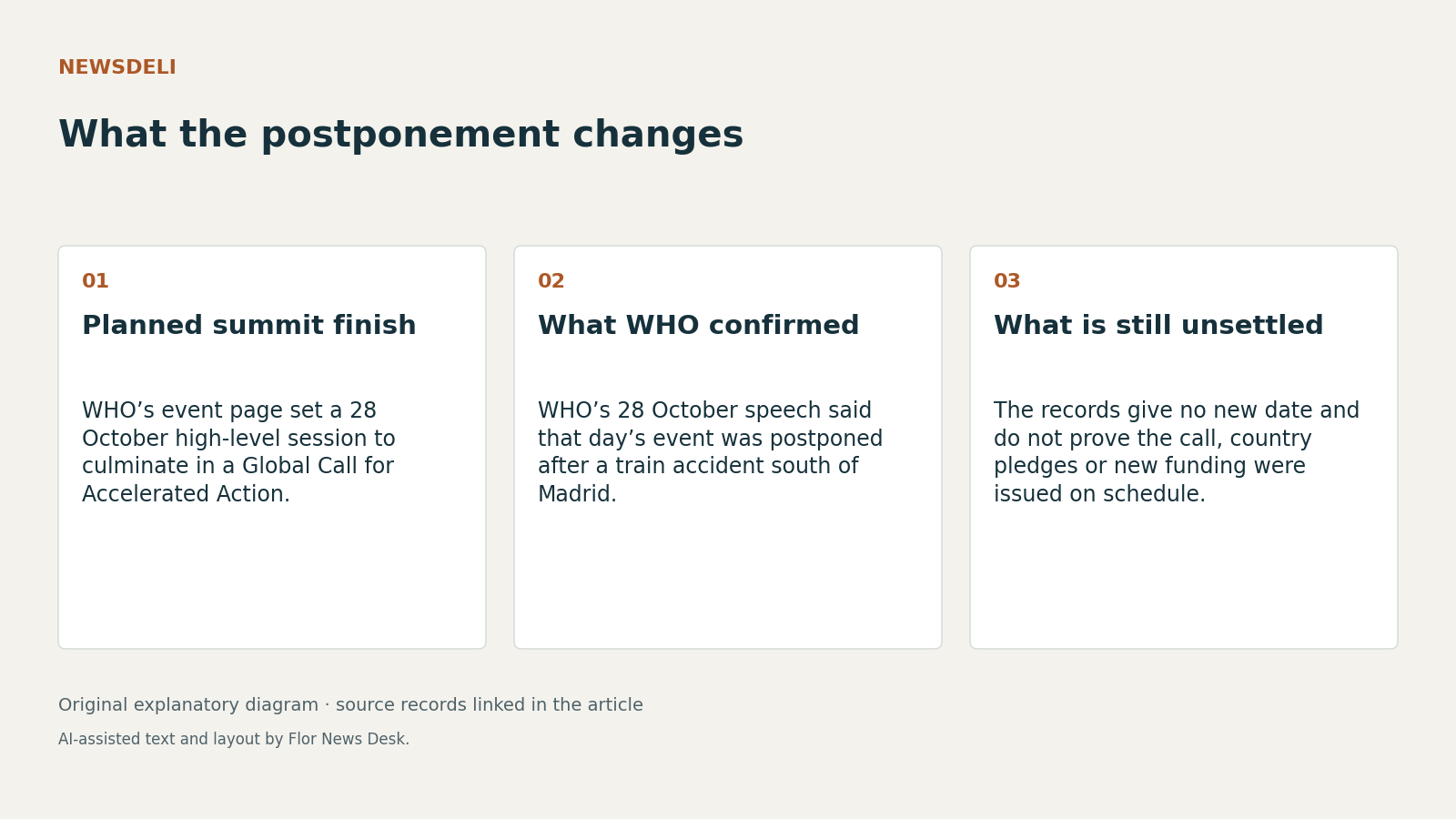
WHO’s 28 October postponement matters less because it rewrites obesity science, and more because it interrupts the summit’s planned political climax. In opening remarks published that day, WHO Director-General Tedros Adhanom Ghebreyesus said a train accident had occurred south of Madrid that morning, that fatalities were already clear, and that Spain’s prime minister and health minister were focused on the emergency response. He said “today’s event” was being postponed to a later time out of respect for victims and families. The same WHO record does not give a new date or define every affected component. WHO speech, 28 Oct 2026
That matters because the WHO summit page had framed 28 October as the point when the three-day Madrid Global Obesity Summit would culminate in a “Global Call for Accelerated Action to Stop Obesity.” WHO says the meeting was co-hosted with Spain’s Ministry of Health, in collaboration with UNICEF and the World Bank, and was meant as a stocktaking moment under the WHO Acceleration Plan to Stop Obesity (2022–2030). Its listed aims included reviewing progress, sharing lessons, setting priorities toward 2030 and securing renewed political commitment through a Global Call for Action (2026–2030). The page also scheduled a high-level session for 10:30 to 13:30 CET on 28 October. WHO event page
The key distinction is between a planned political milestone and an already issued technical product. WHO had already released its first global guidelines on child and adolescent obesity on 7 October. In remarks that day, Tedros said the guidance strongly recommends structured changes to diet, behaviour and physical activity, and addresses medicines, bariatric surgery and weight-loss devices. WHO media briefing, 7 Oct 2026 WHO’s news item adds that the guidance strongly recommends structured interventions, conditionally recommends digital health tools with caregiver supervision, and does not recommend drugs, surgery or devices for children aged 0–9; for adolescents aged 10–19, approved medicines or bariatric surgery may be considered only in limited circumstances. WHO guidelines news item, 7 Oct 2026
So the postponement does not erase the 7 October guidelines. What it does disrupt, based on the records, is the public moment where governments and partner institutions were expected to attach political commitments to that broader obesity agenda. That is an analytical inference from two sourced premises: the event page says the summit would culminate in a call for action on 28 October, while the 28 October speech says that day’s event was postponed. Without a replacement notice or published call, there is no documentary basis yet to say the commitments were made on schedule. WHO event page WHO speech, 28 Oct 2026
The same caution applies to implementation and funding. WHO says 170 million people aged 5–19 were living with obesity in 2024, with prevalence rising from 2% to 8% since 1990, which explains the policy urgency. WHO guidelines news item, 7 Oct 2026 But none of the supplied WHO records shows country adoption of the new guidance, and none records a measurable outcome from the Madrid meeting.
Nor does the World Bank material fill that gap. The summit page names the Bank as a collaborator, but the supplied Bank source is a background publication from 27 January 2020 about obesity’s economic costs and possible policy responses such as labelling, fiscal measures and early childhood nutrition programmes. It says development partners can support countries, but it does not announce new money for the summit or for national obesity plans in 2026. World Bank report page, 27 Jan 2020 WHO event page
As of 28 October, then, the cleanest reading is narrow. WHO’s technical guidance exists; the summit’s scheduled political finale was interrupted; and the public record supplied here does not yet establish a new date, a published Global Call for Accelerated Action, fresh funding, or renewed national commitments.