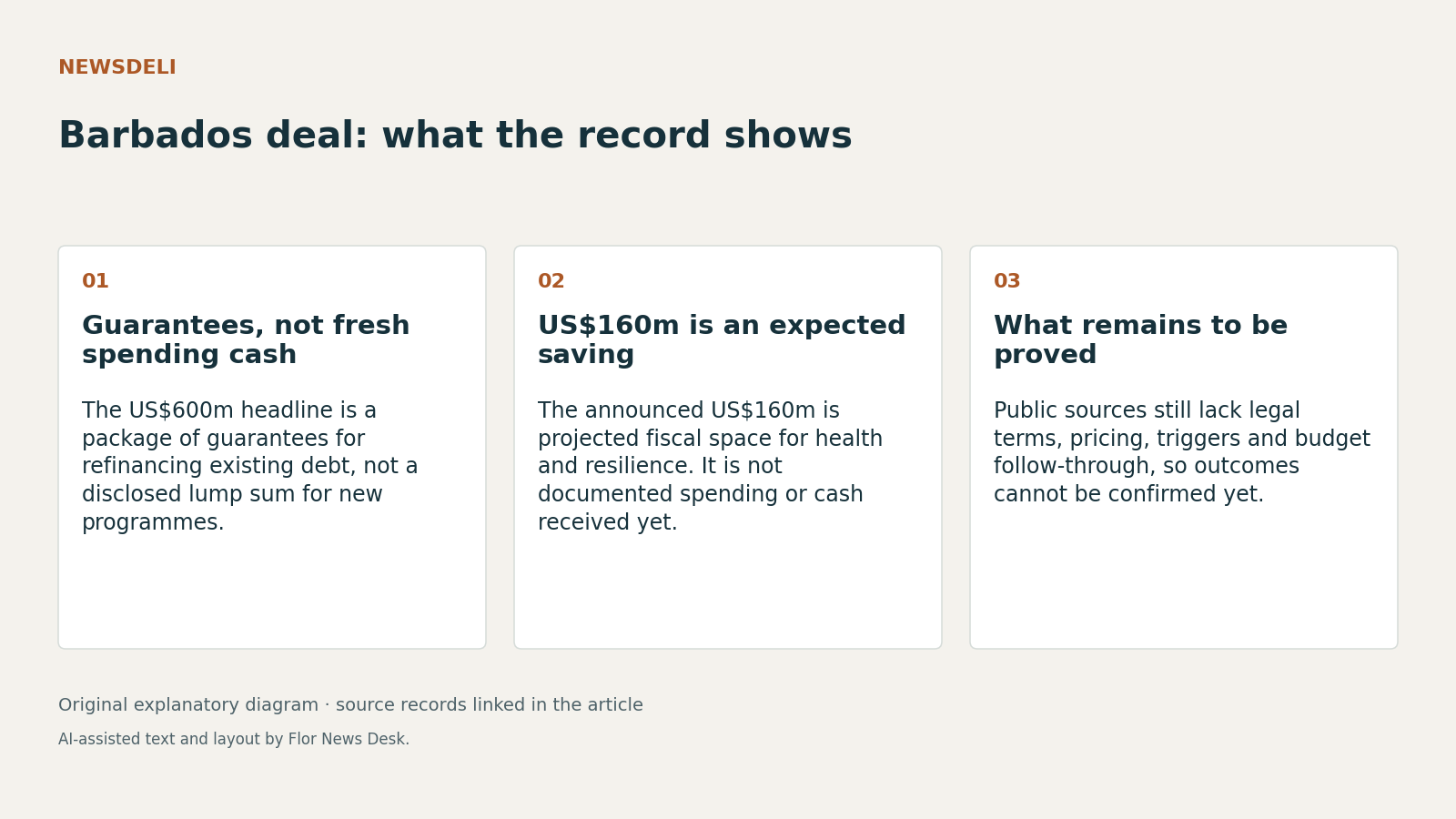
Barbados’ November 18 announcement is important because it is concrete, not just conceptual: the World Bank said four development banks will combine US$600 million in guarantees so Barbados can refinance existing debt on better terms, making it the first country to use the Multi-Guarantor Debt for Resilience Joint Initiative. The same announcement said the structure is expected to create fiscal savings that would support US$160 million in health and resilience investments, while avoiding an increase in the country’s debt burden. Those are significant claims, but they are still claims about an announced transaction, not measured results yet. World Bank press release
What was actually announced is fairly specific. According to the World Bank, the Inter-American Development Bank and the World Bank Group will each provide US$175 million in guarantees, while CAF – Development Bank of Latin America and the Caribbean and the Caribbean Development Bank will each provide US$125 million. The World Bank said its own share combines an International Bank for Reconstruction and Development policy-based guarantee with a Multilateral Investment Guarantee Agency guarantee, and it named Scotiabank and CIBC Caribbean as lead arrangers. It also announced a separate US$6 million grant for a regional public good tied to access to medicines and health supplies. World Bank press release
The key distinction is that guarantees are not the same thing as handing Barbados US$600 million to spend. On the record available so far, the deal is meant to change the terms on refinancing existing debt. In plain language, the guarantee package is supposed to make replacement borrowing look safer to investors, which can improve borrowing terms. That is why the announcement talks about refinancing and fiscal savings rather than new loan proceeds for government programmes. What the public record does not yet show is where those savings would come from in practice: lower interest costs, longer maturities, other structural features, or some mix of them. The press release does not publish signed legal texts, pricing, maturities, or the refinancing timetable. World Bank press release
That missing detail matters because “expected to generate” US$160 million is not the same as US$160 million already received or spent. The announced US$6 million grant is a clearer funding commitment in the public record; the larger US$160 million figure is framed as expected fiscal space linked to the refinancing operation. Until budget documents, financing contracts, or later implementation updates appear, readers cannot tell when those savings would accrue, how they would be allocated between health and resilience, or whether the full amount would materialise. World Bank press release
The risk question is also only partly answered. A guarantee has value precisely because some repayment risk is being backed by the guarantors if specified conditions arise. So the headline benefit for Barbados implies contingent exposure for the four development banks. But the public announcement does not set out the trigger conditions, how any losses would be shared, or how Barbados and the guarantors would report those exposures. Without that, it is too early to draw firm conclusions about where risk has moved beyond the broad point that it has not disappeared. World Bank press release
There is, however, a wider policy context for why this structure is getting attention. At a United Nations side event on September 22, speakers discussed how governments try to create fiscal space for health through measures including taxation, debt swaps and budget reprioritisation, while CARICOM argued that financing should reflect small states’ exposure to repeated shocks rather than income per person alone. That transcript is automatically generated, warns that its audio no longer matches perfectly, and does not mention the Barbados operation. Still, it helps explain the policy problem the Barbados deal is trying to address: how a shock-prone small state can free room for essential spending without simply adding more debt. UN transcript page
So the real test comes later. The announcement establishes that a first multi-guarantor operation has been launched for Barbados. It does not yet establish the final borrowing terms, whether refinancing has closed, how contingent liabilities will be reported, or whether announced savings will turn into documented health and resilience spending. Those are the next records to watch. World Bank press release